October 27, 2026
・
12
mins read
.png)
This executive summary distills the key findings from the new, comprehensive report "Every Link Matters: The State of Supply Chain Cyber Security in Financial Services – UK Edition". It provides C-suite executives, Chief Risk Officers (CROs), Chief Cyber Security Officers (CISOs) and regulatory leads with a high-level overview of the systemic vulnerabilities currently facing the supply chain ecosystem supporting financial sector organisations' critical business functions. For the full analysis, detailed survey data, regulatory context, and suggested solutions for transforming TPRM from a mainly reactive and increasingly ill-suited approach for managing supply chain risk into an active cyber defence discipline, please refer to the complete report.
The UK financial services sector enters 2026 at a critical juncture. The transition toward cloud-native architectures and wholesale digitalisation has created a "visibility crisis" where the distinction between internal systems and external vendors has effectively vanished. Supply chain cyber attacks affected 82% of surveyed firms in the last 12 months, demonstrating that the traditional approach to third-party risk management has reached its functional limit.
While 91% of sector leaders prioritise supply chain risk as a top-tier concern, only 28% of institutions possess "Excellent" visibility into their Nth-party dependencies, where many of today's risks reside. This opacity constitutes a systemic vulnerability that regulators are no longer willing to tolerate. Following the implementation of the FCA's and PRA's Operational Resilience rules, including the Critical Third Party (CTP) regime, and DORA, the focus has shifted from individual firm resilience to the stability of the entire financial sector's supply chain ecosystem.
A primary objective of the new operational resilience regime is to allow regulators to obtain exhaustive data on firms' wider supply chain dependencies—extending deep into the layers of subcontractors and lower-tier suppliers. The implicit goal is to map the wider ecosystem and identify concentration risks and systemic single points of failure before they can be exploited.
However, the industry cannot afford to wait for regulators to achieve this birds-eye view. As demonstrated by a collaborative project of 6 financial institutions with Risk Ledger, firms can take a more proactive approach today. By collaborating with peers and overlaying supply chain maps, institutions can not only achieve real-time visibility and identify shared risks to stay far ahead of the regulatory curve, transforming TPRM from a reactive compliance exercise into a dynamic, proactive defence, they can also reduce resource spend and scale their TPRM programmes.
The UK financial sector serves as the indispensable backbone of the national economy, with the City of London, a global financial powerhouse that processes trillions in transactions and serves as a critical hub for international capital, at its strategic heart. However, this global prominence has placed the sector directly in the crosshairs of increasingly sophisticated adversaries. In 2026, the threat landscape is no longer shaped solely by opportunistic cyber criminals; it is defined by deepening geopolitical crises and the systemic fragility of a hyper-connected supply chain ecosystem.
For financial institutions, the continuing shift toward cloud-based services and a heavy reliance on Information and Communication Technology (ICT) as well as a few critical financial infrastructure providers has created a complex and interconnected web of dependencies and rendered traditional "moat-and-wall" defence models obsolete. Attackers now recognise that the most effective route to a well-defended target is through its less-visible suppliers, exploiting a single breach to potentially reach multiple high-value victims.
The SolarWinds attack has driven home the inherent dangers in our interconnected modern supply chains. As a direct result of the attack, the New York State Department of Financial Services (NY DFS) saw a potentially major threat to the financial system at large and thus immediately required all New York financial institutions to report any impacts the attack had on them. While this attack drew a lot of attention because of its massive "blast radius", there are hundreds of other attacks against the financial services industry through their supply chains each year that receive far less attention. For instance, the 2024 ransomware attack against ION Trading Technologies' cleared derivatives unit. The attack forced ION to take its systems offline, resulting in financial institutions suddenly having to manually confirm trades, causing ripple effects and reporting delays across the sector.
The stakes have been raised further by a stringent new regulatory environment. The UK's Operational Resilience Rules (PS21/3, SS1/21, SS2/21 and most recently PS7/26) and the EU's Digital Operational Resilience Act (DORA) have moved expectations from high-level guidance to rigorous mandates. As of 31 March 2025, firms are required to have mapped their "important business services" and the chain of third and nth-party dependencies necessary to deliver them, ensuring they can remain within tolerable impact levels during severe disruptions. Moreover, these regulations are no longer just aimed at strengthening the operational resilience of individual firms, but of the entire financial sector.
This report thus sets out to examine the state of supply chain cyber security in financial services in the UK, investigating whether traditional risk management practices are evolving fast enough to secure every link in the sector's intricate supply chain ecosystem, or if a fundamental shift in approach is required to safeguard the City of London's and wider financial services sector's continued role as an engine of growth and global financial stability.
While financial services firms commonly have strong cyber defences in place, not least because of the stringent compliance and regulatory requirements the industry has to meet, there remains a clear weak spot: their extended supply chain dependencies.
The integration of more and more new technologies and external partners and vendors has created a web of dependencies that are both opaque and vulnerable to exploitation by threat actors. Supply chain attacks represent an indirect but highly effective pathway to compromising critical economic infrastructure. Rather than attacking a well-defended tier-1 bank or major insurer directly, threat actors increasingly opt to compromise their critical suppliers - such as a fintech startup, a software vendor, or an IT managed service provider - to gain access to their ultimate target's network or data. Supply chain attacks have thus become a defining feature of the modern threat environment, and are aimed at not only direct suppliers but also the extended network of service providers and subcontractors that underpin the financial services industry.
This section evaluates the scale of the threat facing the industry today, analysing the prevalence of supply chain incidents and the structural vulnerabilities and headwinds the sector is facing.
According to the European Union Institute for Network and Information Security's (ENISA) latest finance-sector threat-landscape report (2025), supply-chain attacks are a "key and growing vector" for the sector, as attackers increasingly abuse third-party providers and integrators to reach multiple institutions at once. ENISA's research found that most commonly, supply chain attacks impact financial institutions in the form of exposure and sale of sensitive data (63%), followed by operational disruption (26%), and trailed by financial loss (11%).
In parallel, the World Economic Forum's Global Cybersecurity Outlook 2026 highlights third-party and supply-chain compromises as one of the fastest-rising sources of cyber risk globally, with financial services among the most exposed sectors.
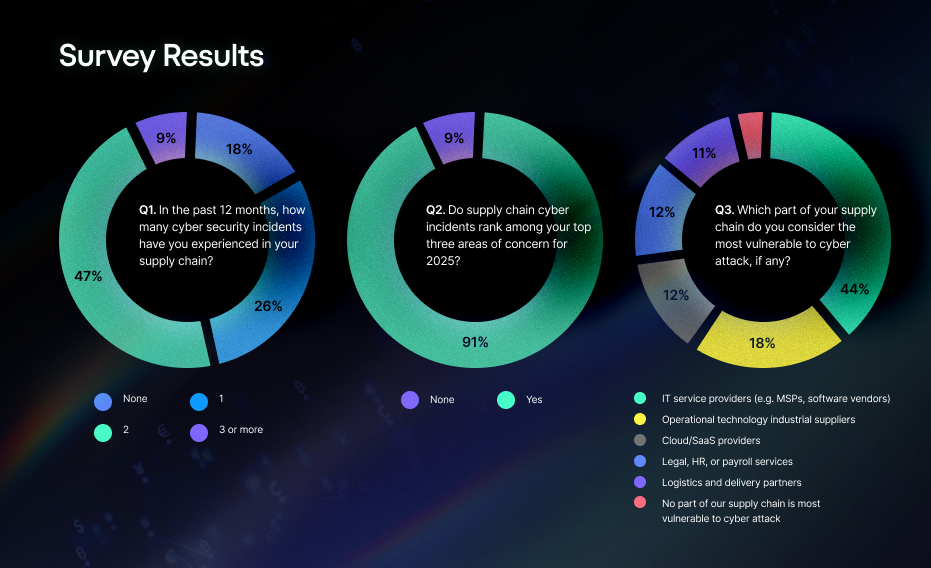
According to our own research, involving cyber security and TPRM leaders across UK financial institutions, 82% of surveyed firms experienced at least one supply chain incident in the past 12 months, with 56% suffering two or more incidents, and nearly one in ten (9%) experiencing three or more. The scale of the challenge has fundamentally altered the perceived threat landscape. Today, 91% of respondents rank supply chain cyber incidents among their top three cyber security concerns.
The risks appear concentrated in specific categories of suppliers. Our survey findings point to IT service providers (44%), such as MSPs and software vendors, as the most vulnerable parts in the supply chain. This is followed by operational technology (18%) and cloud/SaaS providers (12%), reflecting a deep-seated concern that the very tools used for digital transformation are becoming the primary vectors for enterprise cyber risk.
Moreover, the problem with supply chain incidents goes well beyond direct third-parties. As attacks such as SolarWinds, MOVEit Transfer and many others have demonstrated, in many cases, the initial breach that impacted firms and their customers did often not even originate in a direct third-party, but in a 4th party that a critical third-party relied on.
When threat actors, for example, exploited a zero-day vulnerability that was discovered in the file transfer software, they also exfiltrated large amounts of data handled by a company called PBI Research Services, a leading research service provider used by many financial institutions to determine whether their account holders are still alive, or to find beneficiaries. This research provider had used MOVEit Transfer to process its clients' customer data, hence also directly impacting the financial services firms it served as well.
Another example of fourth-party impacts during the MOVEit attack is the case of Zellis, a UK payroll services provider. Only days after Progress Software had published its notice about the discovery of a zero-day vulnerability in its MOVEit Transfer software, it began to emerge that Zellis had confirmed a data breach through their use of the software. Zellis also announced that eight of their clients had been impacted as well. The affected parties included the BBC, British Airways, Boots and DHL, among others.
These examples demonstrate that without greater awareness of what is happening further down the supply chain, it becomes almost impossible to anticipate potential threats that might suddenly surface at 4th, 5th or 6th parties and beyond, but then ripple up and come to affect a financial services firm directly.
The situation is further complicated by a rapidly worsening geopolitical situation and is inextricably linked to the broader fracturing of the global order. The National Cyber Security Centre (NCSC) and other bodies have noted that the wars in Ukraine and shifting alliances have emboldened threat actors to explicitly target Western financial systems. The emergence of groups such as the 'DarknetParliament'—a coalition involving KillNet, REvil, and Anonymous Sudan—signalled a new era of cyber aggression. Their coordinated campaigns in 2023, such as those announced under 'Decision No. 0191,' specifically aimed to attack the foundational pillars of international finance, including SWIFT, IBAN, and SEPA messaging protocols.
For the UK financial sector, these tensions translate into a "live-fire" test of operational resilience.
While ransomware gangs motivated by financial gain remain a persistent nuisance, the primary concern for the UK financial sector is increasingly becoming the rise of sophisticated, state-sponsored adversaries. For these actors, the motive shifts from simple extortion to strategic sabotage, disruption, and pre-positioning within the global financial architecture.
The escalation of supply chain attacks amidst an increasingly complex geopolitical environment raises a fundamental question: is the prevailing methodology of Third-Party Risk Management (TPRM) still an effective bulwark against modern cyber threats emanating from organisations' supply chain dependencies? The persistent rise in organisations and entire industries being impacted by supply chain incidents suggests that there might be inherent, structural flaws with the traditional TPRM model.
The core paradox lies in the scope of the task: while organisations rightly prioritise the security of their own internal applications, people, and governance, TPRM effectively requires them to apply the same level of rigour to their hundreds or even thousands of external suppliers and partners as well. Using current methodologies, this has become a seemingly impossible mandate. Traditional TPRM, whether using manual spreadsheets or digital tools, remains, in essence, a point-in-time compliance-driven, one-to-one assurance exercise that is siloed and can't be easily scaled.
As firms pivot to meet the "non-delegable" accountability standards of the Bank of England's (BoE's), Financial Conduct Authority's (FCA's) and Prudential Regulation Authority's (PRA's) Operational Resilience rules, and the EU's Digital Operational Resilience Act (DORA), the gap between what traditional TPRM can deliver and the requirement to achieve genuine operational resilience has become wider and wider.
The second section of this report will investigate whether there are inherent flaws with traditional TPRM that prevent it from producing better security outcomes.
Our survey data reveals a sector that is increasingly skeptical of its existing risk management toolkit. When asked about the effectiveness of traditional TPRM in mitigating modern supply chain cyber risk, professional confidence is lukewarm at best. While 42% of respondents consider their TPRM programme as "very effective", 56% described TPRM as only somewhat effective, with 2% rating it as "not very effective". The core dilemma is that TPRM, while meeting compliance requirements, often fails to translate into stronger security or resilience against supply chain attacks because occasional supplier assessments are detached from real-time operational risks.
One of the leading technical deficiencies identified by industry professionals is the pervasive "Monitoring Gap". The survey insights reveal the stark inadequacy of point-in-time risk assessments, with currently only 40% of organisations performing continuous monitoring of their critical suppliers, with the remainder relying on quarterly (28%), biannual (18%), or even just annual (12%) review cycles.
There is also a strong likelihood that the fairly high number of respondents claiming to have the ability to continuously monitor their critical suppliers might have based this assessment on their organisation's utilisation of external scanning tools. While external scanning tools can assess a vendor's public-facing perimeter, they remain blind to internal hygiene factors—such as network segmentation, privileged access management, and employee training—that are critical for preventing lateral movement during an attack. This is why 38% of practitioners pointed to the inability to continuously monitor a supplier's internal security controls as a key shortcoming of traditional TPRM. This "Point-in-Time" problem creates extensive windows of invisibility, during which a new vulnerability, new shadow IT or a configuration error can remain undetected until they are exploited.
Another key weakness, as identified by 40% of respondents, is the lack of collaboration and information sharing with industry peers. This suggests that the tradition of siloed defence is now rightly viewed as a barrier to identifying sector-wide threats and achieving enhanced resilience.
Perhaps most crucially, however, 35% of the sector identified a lack of visibility into deeper supply chain dependencies (Nth-parties) as a key shortcoming, leaving firms exposed to risks buried deep within their digital dependencies.
As the frequency and impact of supply chain attacks continue to escalate, it has become evident that traditional Third-Party Risk Management (TPRM) frameworks are structurally ill-suited to defend against the modern threat landscape. Historically built as a one-to-one, compliance-driven exercise, legacy TPRM fundamentally struggles to scale to the reality of today's deeply interconnected digital ecosystems.
The core dilemma is that standard TPRM practices prioritise checking regulatory boxes over establishing genuine operational resilience. Because these assessments are generally static and detached from real-time operational risks, they create a false sense of security.
Industry practitioners recognise that these foundational flaws cannot be resolved simply by throwing more headcount or budget at the problem. The methodology itself is restricted by severe monitoring gaps, a lack of deep-tier visibility, and an over-reliance on siloed defences. As regulatory bodies introduce stricter mandates—such as DORA and the new UK operational resilience rules—requiring continuous, automated, and comprehensive assurance, it is clear that TPRM must evolve from a reactive compliance function into a dynamic, continuous, and collaborative cyber defence discipline.

The findings of the previous chapters indicate that while the worsening threat landscape and the structural limitations of legacy TPRM are well-documented, the persistent opacity of the extended supply chain represents the sector's primary systemic risk exposure.
As financial institutions transition from managing contracts and direct suppliers' security postures to grappling with the complexity of today's intricate and interconnected digital ecosystems, the risk has effectively migrated into the opaque layers of 4th, 5th, and Nth-party environments.
This section argues that the sector has reached a visibility plateau: as a result of this lack of visibility into their extended supply chains, firms are unable to identify concentration and systemic risks, or even to fully map all the nth-tier dependencies that support their Important Business Services, although this is something that regulators now expect.
There are different types of concentration risks. Concentration risks can arise when a single organisation relies too heavily on one particular supplier for several business critical services, or when several critical direct suppliers of an organisation all depend on the same fourth-party provider for a critical service or function. It is these dependencies that can introduce single points of failure, i.e. when a disruption at this supplier could cascade rapidly, impacting operations far beyond the immediate contractual relationship. Systemic concentration risks, meanwhile, are an extension of concentration risks facing individual organisations. They stem from shared suppliers, whose disruption would have a cascading impact across multiple organisations within the financial services industry.
The industry's reliance on a relatively small number of key technology providers, data processors, and service partners amplifies the impact of such concentration risks.
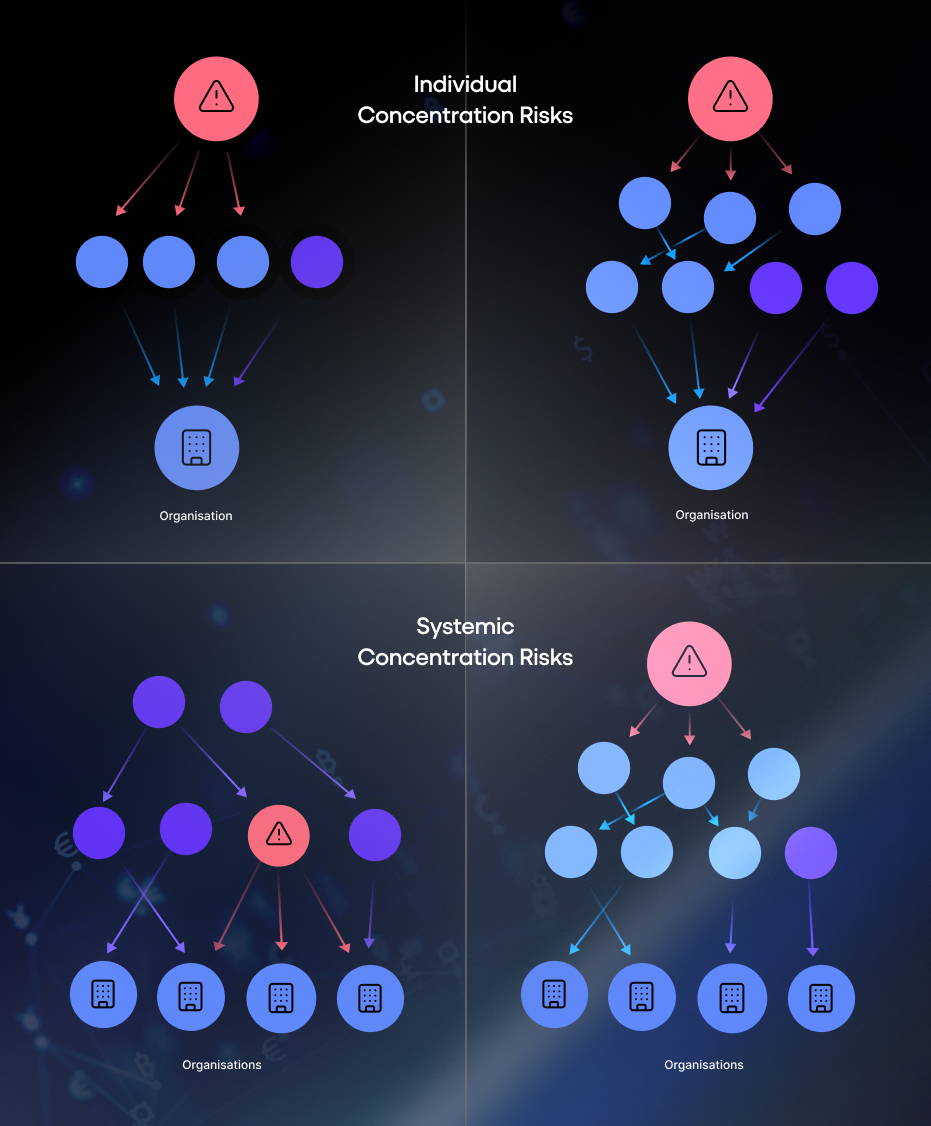
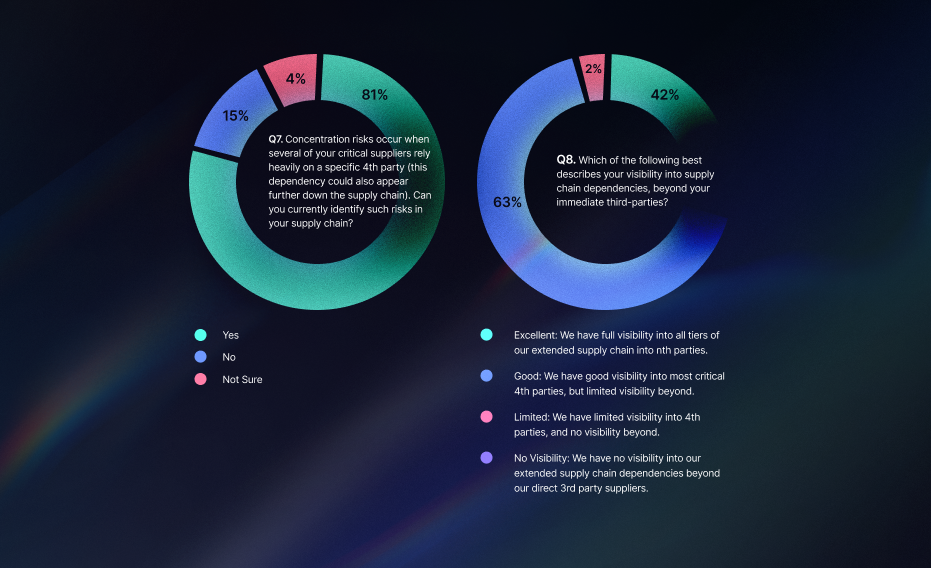
While 81% of industry respondents confidently assert their ability to identify these risks, the reality is that such risks are often obscured within deeper-tiers in organisations' supply chains, where such concentration risks often reside.
Regulators increasingly recognise how suppliers can also represent systemic risks, especially for sectors like finance and critical national infrastructure, where an incident at a widely shared supplier could lead to a domino effect impacting an entire sector. For instance, the FCA's FG 16/5 explicitly requires firms to "monitor concentration risk and consider what action it would take if the outsource provider failed." Similarly, the EU's Digital Operational Resilience Act (DORA), under Article 25(5), expects entities to assess whether contractual arrangements might "reinforce ICT concentration risk," while the Prudential Regulation Authority (PRA) demands comprehensive documentation to enable authorities to supervise these aggregate systemic risks.
In order to be able to identify concentration and systemic risks, however, enhanced visibility into extended supply chain dependencies is key. As the UK Government Cyber Security Strategy (GCSS) correctly observed, "visibility is the foundation from which an accurate assessment of risk can be derived." Without this foundation, the "central mapping" required to understand dependencies on critical and shared suppliers remains incomplete, leaving the sector vulnerable to incidents that could simultaneously paralyse the nation's ability to conduct real-time settlements or manage liquidity.
The foundational importance of enhanced visibility is thus a core pillar of modern resilience. Despite a high awareness of this necessity, a significant "Reality Gap" persists: only 28% of survey respondents claim to have "Excellent" or full visibility across all tiers of their extended supply chain.
The majority (63%) possess visibility only into their most critical 4th parties, while 9% operate with limited insight that does not extend beyond their direct contractual partners. This is a critical shortcoming because, as the GCSS highlights, only an "improved understanding of suppliers and their dependencies will... enable [entire sectors of the economy] to better respond to cyber security incidents that emanate from the supply chain."
Moreover, to move from individual risk awareness to enhanced sectoral resilience, the UK financial sector must embrace the spirit of the new operational resilience rules in the UK and EU, which treat critical third parties as well as their critical suppliers all as an extension of the institution's own infrastructure. This requires shifting the focus from "who we contract with" to "who is touching our Important Business Services," regardless of their position in the supply chain. By adopting the "central mapping" approach advocated by the UK government, the industry can identify the systemic and aggregate supply chain risks that individual firms, acting in isolation, simply cannot see.
In this interview with Risk Ledger, Yohann Le Grand provides an industry perspective and elaborates on the importance of uncovering concentration risks in the supply chain for financial services firms, and offers his thoughts on the role collaboration with peers can play in addressing this challenge collaboratively.

Risk Ledger sat down with Yohann to discuss why uncovering concentration risk is critical to financial services firms, and his thoughts on how the industry can collaborate to address it.
1. How important do you think is the ability to identify individual concentration risks for organisations to achieve better supply chain security and operational resilience?
Identifying concentration risks is key to evaluating and preparing for the potential impacts of a disruption at a critical 4th party.
2. How important is it in your opinion to identify shared systemic risks facing your wider industry, and who should be responsible for identifying and addressing them, e.g. individual organisations, regulators or others?
Identifying the systemic risk is really important as all organisations, both within and outside the industry, are interlinked through banking services at the very least. Individual organisations should already have identified, evaluated, and prepared for risks from individual third parties as part of their supply chain management activities. Maintaining good resilience at an individual level plays a major part in minimising systemic risk. However in most cases, only industry-level associations have enough combined resources and adequate information sharing guardrails in place to efficiently identify actual systemic risks, agree actions and, with the help of regulators, influence large players in the supply chain.
3. Do you think current regulatory frameworks adequately address concentration and systemic risks in supply chain cybersecurity? What improvements would you suggest?
In the UK, current regulatory guidance (e.g. CQUEST) is focussed on the responsibilities of individual financial services companies. In the EU, DORA is going some way to improve supply chain resilience. Industry associations should leverage this to develop a common response to systemic risks.
4. What actions do you currently take on the back of any concentration risks you can identify in your extended supply chains, i.e. do you work with your critical suppliers to better understand the role and importance of concentration risk suppliers to them, and learn more about specific risks that might emanate from them?
We routinely ask our critical suppliers to confirm who their critical suppliers are with a view to both identify concentration risks and perform some due diligence on these subcontractors where necessary. This allows us to understand potential impacts more accurately and refine our operational resilience accordingly.
5. What additional contextual information on potential concentration risks would be useful to make information more actionable for you in the future?
There are two things we need: 1) information about who the subcontractors/Nth parties are, and 2) information about what their resilience/security posture is like.
6. Can you think of ways for how, in the future, it might be possible to identify potential attack paths based on the criticality of services provided down the chain from a possible concentration risk at a 5th degree level or higher into 4th parties, 3rd parties and organisations themselves?
Absolutely, as long as we can get the visibility of the deep supply chain. Inadequate contractual limitations can unfortunately hinder that process which is where regulation such as DORA is beginning to help, but more needs to be done from both a regulatory and industry angle.
7. Which role do you envision enhanced collaboration with industry peers to play in order to better identify and mitigate concentration risks and achieve better supply chain security and operational resilience more generally, and how could you envision such enhanced collaboration to look like?
Proactive information sharing about supply chains, contracts and regulation allowing, is the key to enabling the industry to better and more easily identify and manage its concentration risks. The work that Risk Ledger and FS-ISAC are doing is a start. However, industry peers need to continue to work much more closely to assert greater influence over third and Nth parties so we are able to obtain and share information about their security and resilience.
8. Does the TPRM team or role in your organisation regularly collaborate with your threat intelligence and operational resilience teams?
Absolutely, our information security and TPRM functions are in constant communication.
9. How often does your TPRM team or function collaborate with industry peers or participate in information-sharing initiatives with industry peers related to supply chain security?
We are part of several information sharing organisations within our industry and we interact with them daily.
10. Could you give us 3 ideas for how organisations could more effectively identify and address concentration risks in their supply chains in the future?
The modern financial threat landscape has fundamentally shifted. Cyber risks are no longer confined to direct, critical third-party providers, but have migrated deep into the opaque layers of fourth, fifth, and nth-party extended supply chains. Regulators have recognised this escalating complexity and are recalibrating their approach to focus on the continuity of Important Business Services. Under new operational resilience frameworks, regulated entities bear the responsibility for securing not just their direct suppliers, but the entire underlying chain of dependencies that support these critical functions. This includes the critical mandate to identify hidden concentration risks—such as a primary and backup supplier relying on the exact same fourth party - which could trigger simultaneous, cascading failures across an organisation's operations.
However, a severe "visibility gap" prevents most organisations from achieving this; traditional risk management leaves firms blind to the complex dependencies residing at the fourth-party level and beyond. Recognising this systemic fragility, regulators are now expanding their mandate from individual corporate resilience to the stability of the entire financial sector. By demanding exhaustive data on deep-tier dependencies from regulated entities, regulatory bodies aim to centrally map the wider supply chain ecosystem. This macro-level visibility is designed to expose shared systemic risks and single points of failure that individual firms, acting in isolation, cannot see, ultimately shifting the industry toward collective resilience.
The systemic nature of the supply chain threat implies that individual resilience is no longer a sufficient defence for the UK financial sector. If a multitude of banks, insurers, and payment providers rely on the same critical technology suppliers, they are essentially sharing the same risks. This section argues that enhanced collaboration is the only viable mechanism to solve the systemic visibility crisis inflicting the financial sector. By moving towards a "Defend-as-One" model, however, the sector can leverage shared platforms to turn isolated, repetitive risk assessments into collective, real-time risk intelligence. This approach recognises that in a highly interconnected Critical National Infrastructure (CNI) environment, a vulnerability in one link in the extended and interlocking supply chain is a vulnerability for all.
Collaboration between industry peers is increasingly recognised as becoming essential to effectively manage cyber security risks and enhance sectoral resilience. No single financial services company, regardless of size or sophistication, can address these challenges in isolation.
By sharing insights, threat intelligence, and best practices, organisations can gain greater visibility into potential vulnerabilities and identify systemic concentration risks, build collective resilience, and respond faster and more effectively to evolving cyber threats. Fostering stronger partnerships and open communication across the industry can help transform supply chain security from a fragmented challenge into a unified defence strategy.
The transition to utilising collaborative supply chain security platforms allows for the secure aggregation of supply chain data, which can automatically generate a deep-tier map of the UK financial ecosystem's dependencies. This collective mapping instantly reveals concentration and systemic risks that would otherwise remain invisible to individual firms working in isolation. When a new weakness emerges in the defences of a specific specialised software provider, a collaborative defence platform also allows the entire sector to instantly identify shared exposure and coordinate a unified, rapid response.
Despite the clear benefits, current collaborative efforts within the UK financial sector remain inconsistent and primarily reactive. Our survey data reveals a significant "Collaboration Gap": only 43% of organisations engage regularly with their peers on systemic risk identification, while a vast 55% do so only occasionally and 2% rarely or never collaborate with their TPRM colleagues beyond their own institutional boundaries.
While the exchange of threat intelligence with peers is maturing in many industries, the sharing of supplier risk intelligence - the technical assessment of whether a shared supplier is actually secure and insights into security control weaknesses - remains stagnant due to perceived competition concerns as well as technological and potential legal barriers.
The industry itself is signaling a desire for change, with 42% of respondents advocating for the upcoming Cyber Security and Resilience Bill to provide greater incentives or even mandates for cross-industry collaboration and information sharing. This aligns with the legislative intent to recognise that a collective failure poses a stark national security risk, necessitating a coordinated response across CNI sectors.
Across the UK's most critical sectors, some organisations are already embracing this new model of collective defence, working together to identify supply chain risks that no single entity could identify on its own. By leveraging Risk Ledger's collaborative supply chain security platform, organisations can now join forces with their industry peers to securely share their respective supply chain maps, best practices, and risk intelligence. This new ethos to Defend-as-One yields tangible results, as the following data from the Risk Ledger platform demonstrates.
In one such instance, Risk Ledger brought together a group of 8 of its financial services clients to form a community of peers on its platform to help them identify shared concentration risks and respond faster to emerging threats when they appear. By utilising Risk Ledger and overlaying their respective supply chain maps, the institutions gained unprecedented visibility into their extended supply chains, identifying not just shared direct suppliers but also 4th, 5th, and nth-party dependencies.
Based on an aggregate total of only 98 direct third-party supplier connections of these financial services clients, the platform was able to identify 1,220 further dependencies in their overlapping extended supply chains:
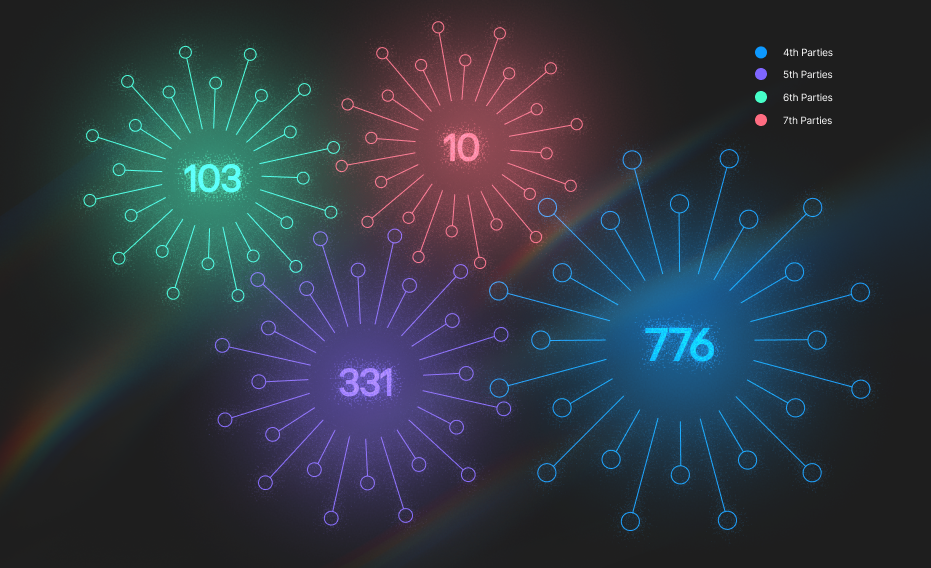
Most importantly, by overlaying their respective network maps on Risk Ledger, community members discovered:
It is still common for organisations to assess each individual supplier on their own, so there remains a vast amount of duplicated effort across organisations when performing these reviews. By sharing information on their suppliers' security practices and controls, and then collaborating with peers across the industry on making the weakest nodes in the system stronger collectively, we can save a lot of time and resources. Even more importantly, it enhances the security of the entire ecosystem.
Also, with most Third-Party Risk Management programmes focusing on direct supplier relationships only, they miss the extended web of dependencies and shared vulnerabilities that exist across the industry and could become single points of failure. Greater collaboration with industry peers that often share substantially overlapping supply chains can overcome many of the current shortcomings with TPRM. Specifically, collaboration enables organisations to:
The UK financial services sector stands at a critical juncture, as traditional security paradigms are being outpaced by a new era of digital supply chain complexity and risk. As established throughout this report, the transition toward a hyper-connected digital ecosystem has coincided with intensifying geopolitical instability and a professionalisation of supply chain attacks.
For many organisations, these external pressures, compounded as they have been by an increasing drive toward digital sovereignty, including in the UK and Europe, represent potentially existential challenges to sectoral resilience. Despite the sector possessing some of the most mature cyber security functions in the world, the results remain sobering, the continued prevalence and high frequency of successful supply chain incidents suggests that there are inherent flaws with traditional, questionnaire-driven Third-Party Risk Management (TPRM) approaches that cannot be resolved through the mere injection of additional capital or manpower.
As this report has found, the fundamental weakness plaguing the industry is a widespread lack of visibility amidst the exponential rise in the complexity of the sector's supply chain ecosystem. This "visibility gap" is particularly perilous because the threats to Important Business Services and the stability of the UK financial infrastructure do not respect contractual tiers; a vulnerability in a deep-tier subcontractor can propagate through the system with the same lethality as a direct supplier compromise.
Regulators, including the Bank of England, the FCA, or the ECB have recognised this structural fragility, shifting their focus toward system-level resilience through frameworks like the Critical Third Party (CTP) regime and the wider Operational Resilience rules. These regulations aim to map the wider ecosystem and identify the single points of failure that could trigger a cascade of operational paralysis.
However, the industry cannot afford to remain reactive while regulators build this capacity. Enhanced collaboration and the proactive sharing of supply chain intelligence offer the most effective path forward, as demonstrated by the successful application of the Risk Ledger network model within a group of financial services clients and within other CNI sectors. This new approach transforms TPRM from a reactive, point-in-time compliance exercise into an active cyber defence discipline. By collaborating with peers and overlaying supply chain maps, the UK financial sector can move beyond the "Compliance Trap" and build a proactive, coordinated defence capable of safeguarding not only individual organisations' resilience, but sectoral resilience and national economic stability in an increasingly hostile threat environment.
Understanding hidden dependencies is one thing. Knowing where they exist across your own supply chain is another.
Take the Supply Chain Risk Exposure Assessment to evaluate your current visibility, identify potential gaps and see where your organisation may need to go further.

Supply chain attacks are a primary risk vector for UK financial institutions. Research shows that 82% of surveyed UK financial services firms experienced at least one supply chain incident in the past 12 months, with 56% suffering two or more incidents. Furthermore, 91% of industry risk leaders rank supply chain cyber incidents among their top three cybersecurity concerns.
According to industry research, IT service providers (such as Managed Service Providers and software vendors) represent the most vulnerable link, cited by 44% of financial sector respondents. Other vulnerable areas include:
Traditional TPRM relies heavily on static, point-in-time audits and annual questionnaires that fail to reflect real-time operational cybersecurity risks. Industry professionals highlight the following critical TPRM shortcomings:
Concentration risks occur when critical dependencies converge on a small number of shared suppliers:
Under the UK's Operational Resilience rules (including PS21/3, SS1/21, SS2/21, PS7/26, and the Critical Third Party regime) and the EU's Digital Operational Resilience Act (DORA), financial institutions must:
A "Defend-as-One" approach transitions the industry from isolated, repetitive vendor audits to collective real-time risk intelligence sharing. By overlaying supply chain maps on collaborative security platforms, financial institutions can:



Monthly research, case studies and practical guides you won't find anywhere else.
Join thousands of security managers turning their TPRM programmes into success stories.


.svg)